

Opsydia is pleased to announce that its P5000 Adaptive Optics Direct Laser Writing system has been nominated for the ECOC Exhibition Industry Awards 2026 in the Optical Component Innovation Award category. The awards recognise excellence and innovation across optical communications, highlighting technologies that are shaping the future of optical transport, networking, fibre-based products, photonic integrated circuits and related sectors.
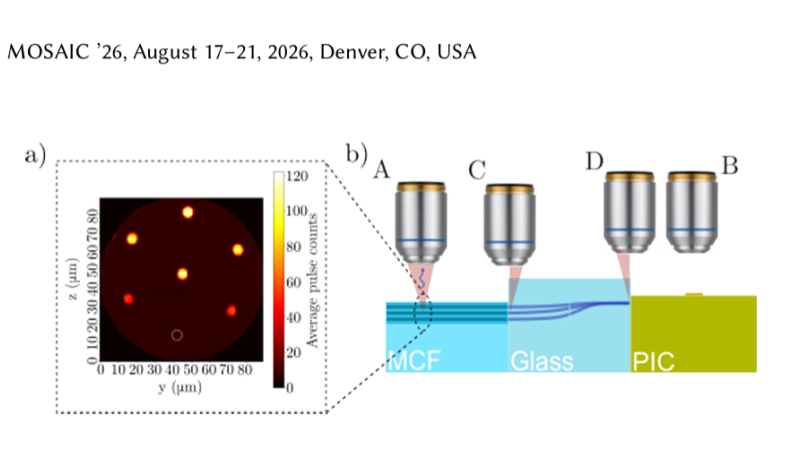
The P5000 has been developed to address one of the most important challenges in photonic packaging: creating scalable, high-density optical links between fibre arrays and photonic integrated circuits. Using a femtosecond laser, the system writes low-loss optical waveguides in three dimensions inside a range of glass substrates, enabling efficient edge coupling without the need for active alignment.
Designed specifically for photonic interconnects, the P5000 can accurately identify fibre cores and PIC fiducials before writing optical links directly between the required ports. Its integrated adaptive optics unlock stable, complex 3D waveguide designs, supporting fast, repeatable packaging at high density.
Key features of the Opsydia P5000 include:
The winners will be announced live at the Product Focus theatre in Pavilion 1 of the Exhibition Hall on Monday 21 September from 15:40 during the ECOC Exhibition 2026 in Málaga.
Opsydia develops and manufactures advanced laser processing systems for next-generation optical packaging and photonic integration.
Our machines combine proprietary laser technology, adaptive optics, and machine vision to create precision 3D optical waveguides directly inside transparent materials. This enables optical connections to be formed between photonic devices and optical fibres with unprecedented flexibility and accuracy, reducing packaging complexity and improving performance.
Today, Opsydia works with leading companies across the datacom, telecom, and quantum ecosystems to enable scalable, high-density optical interconnects for future generations of photonic systems.