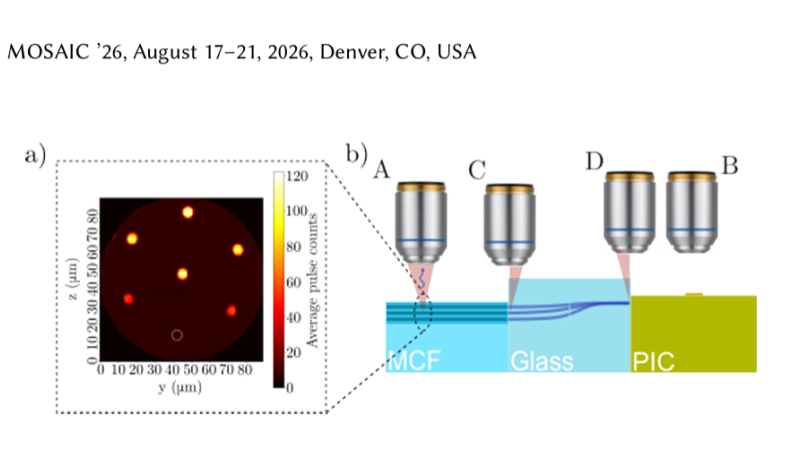

The funds will be used to rapidly bring to market and deploy Opsydia’s waveguide writing technology, for deployment into optical interconnects in high bandwidth and high-density applications.
Nigel Vaughan, Executive Chairman, Opsydia said:
“The increase in datacentre bandwidth demands driven by AI and other applications will require a new approach to optical connectivity.
Opsydia’s adaptive optic approach supports these goals by allowing users to directly write waveguides in optical connectors right to the edge and with extremely low insertion loss.
Our approach also supports emerging density demands as we have demonstrated arrays of waveguides that are likely to dramatically improve bandwidth performance.”
Chris Wiles, Director, Foresight VCT commented:
“We are very interested in technologies that deliver order of magnitude improvements in performance or cost in a sustainable way.
Opsydia’s unique technology will help remove fundamental bottlenecks in communications bandwidths while also reducing the cost and energy associated with current manufacturing methods.”
Alun Williams, Investment Director, Parkwalk Advisors said:
“Overcoming the impending bottlenecks industry is facing due to the surge in bandwidth demand driven by AI applications requires innovative thinking on topics such as connectivity and co-packaging of optics.
Opsydia is uniquely poised to deliver solutions addressing these and other challenges.”
Prof. Martin Booth, Founding Scientist, Opsydia stated:
“As device architectures become more complex, new platforms are needed to continue driving innovation.
Our systems level approach allows us to optimise device fabrication by adapting the ultrafast laser fabrication based upon precision microscopic measurements. This unique capability provides exciting opportunities for the field."
Opsydia provides commercial systems based on adaptive optics which can directly generate photonic structures in a variety of transparent materials. Waveguides for optical connectivity can be written directly point to point and in three dimensions, opening new possibilities in device design. Learn more at opsydia.com.