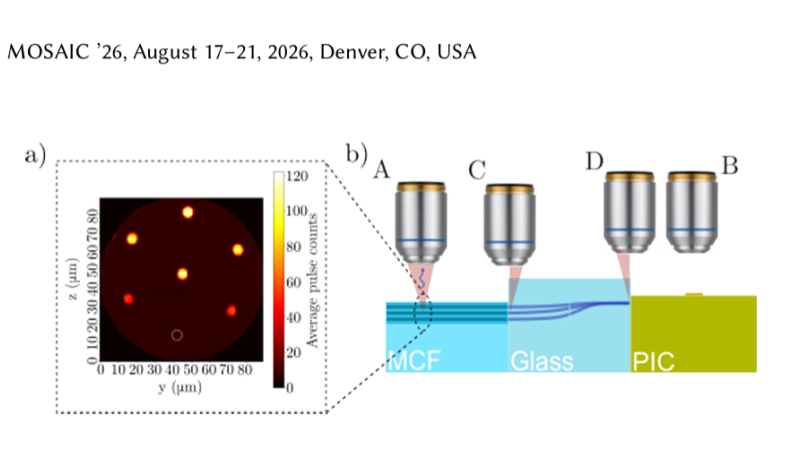

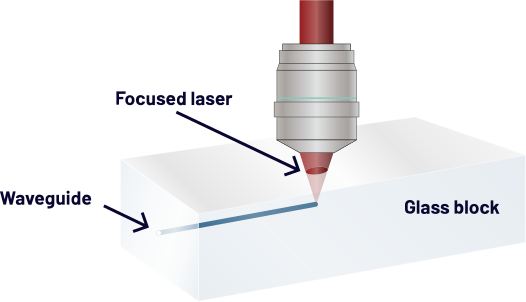
In order to write waveguides, we simply focus a laser into a transparent sample, such as glass. This creates a local change in the glass that has different optical properties (index of refraction) compared to the glass around it. When we then move the glass or the laser beam, we trace a path which becomes an optical “channel” or waveguide. This happens because the light (wave) is confined (guided) to the channel created by the path of the laser through the material (glass).
In simple terms, waveguides can be used to move light from one place to another. They are not a one-size-fits-all solution and there are many ways to move light (e.g. via fibre, via ‘free-space’ i.e. sending the laser beam through air and others). Which method of transport the user chooses depends on the particular needs of the device or application they have, but in general, waveguides are often chosen when:
A waveguide can be In the order of 10-20μm. While the core of a single mode fibre is ~9.5μm, the cladding on the fibre takes the size to 127μm or more. Waveguides can potentially be packed quite close together, but fibres are limited by the size of the cladding. The familiar example of this is in the area of chip-to-chip communication or transceiver applications, but other applications such as AR/VR/MR are emerging where space limitations are also driving the adoption of waveguides.
Since the glass connectors can be very small, propagation can be kept to a minimum. Waveguides written in glass suffer from relatively higher loss at 0.2dB/cm, while single mode fibres have losses of 0.2dB/km (note cm vs km!!)