

Artificial Intelligence (AI) and high-performance computing are driving exponential growth in bandwidth demand, exposing fundamental limitations in copper-based interconnects. At data rates above 200 Gbps, copper suffers from signal degradation, thermal inefficiency, and range limitations—creating a growing bottleneck for chip-to-chip communication. To address this, the semiconductor industry is exploring glass and other transparent materials as next-generation substrates for advanced packaging due to their mechanical stability, low coefficient of thermal expansion (CTE), and optical compatibility.
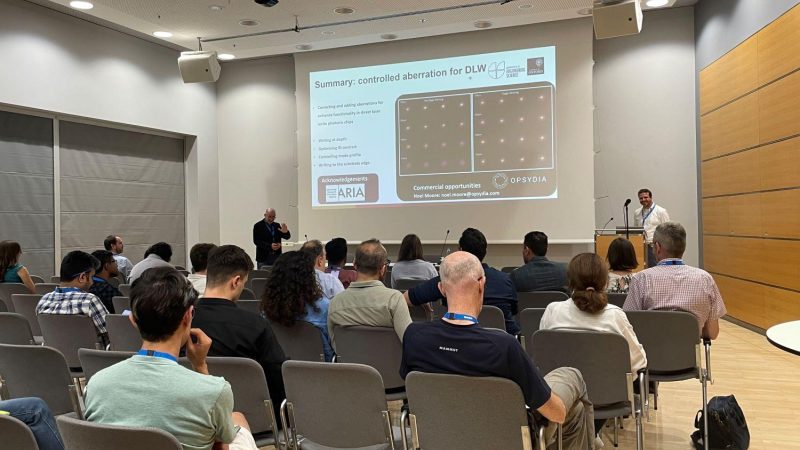
It is possible to form high-aspect-ratio, electrically conductive channels with arbitrary 3D geometry—referred to as non-line-of-sight (NLOS) vias – in transparent substrates such as glass, sapphire and others. Using Opsydia’s adaptive optic femtosecond laser writing, precursor tracks can be patterned with micron-scale accuracy, enabling the creation of vias that are curved, tapered, or blind—overcoming the geometric constraints of conventional vertical drilling.
Several important industry leaders such as Intel, Samsung and Corning are leading the way in the development of glass as a substrate material for interposers. There are many reasons for this including that glass is mechanically rigid, well behaved thermally and can be manufactured very cheaply.
It should be noted that glass is an electrical insulator and techniques to provide the electrical connections for a glass interposer are receiving a lot of attention. One approach of interest is Laser Induced Chemical Etching, wherein an ultrafast laser processes an area of glass, which is subsequently removed with a wet, alkaline etch and back filled with a metal to provide the electrical connections. As the Opsydia system could do the laser processing step directly, we are investigating this as an additional area for the company.